Enterprise AI memory layer ·


Designing the memory an AI agent is allowed to have.
ProductGTM
- #453
- of 18,000+ MCP servers on PulseMCP
- 6
- AI-agent discovery registries listed
01
Overview
- Role
- Product Manager
- Timeline
- 2026.05 — present
- Platform
- Web App · MCP · AI Agents
- Scope
- v2 direction, GTM
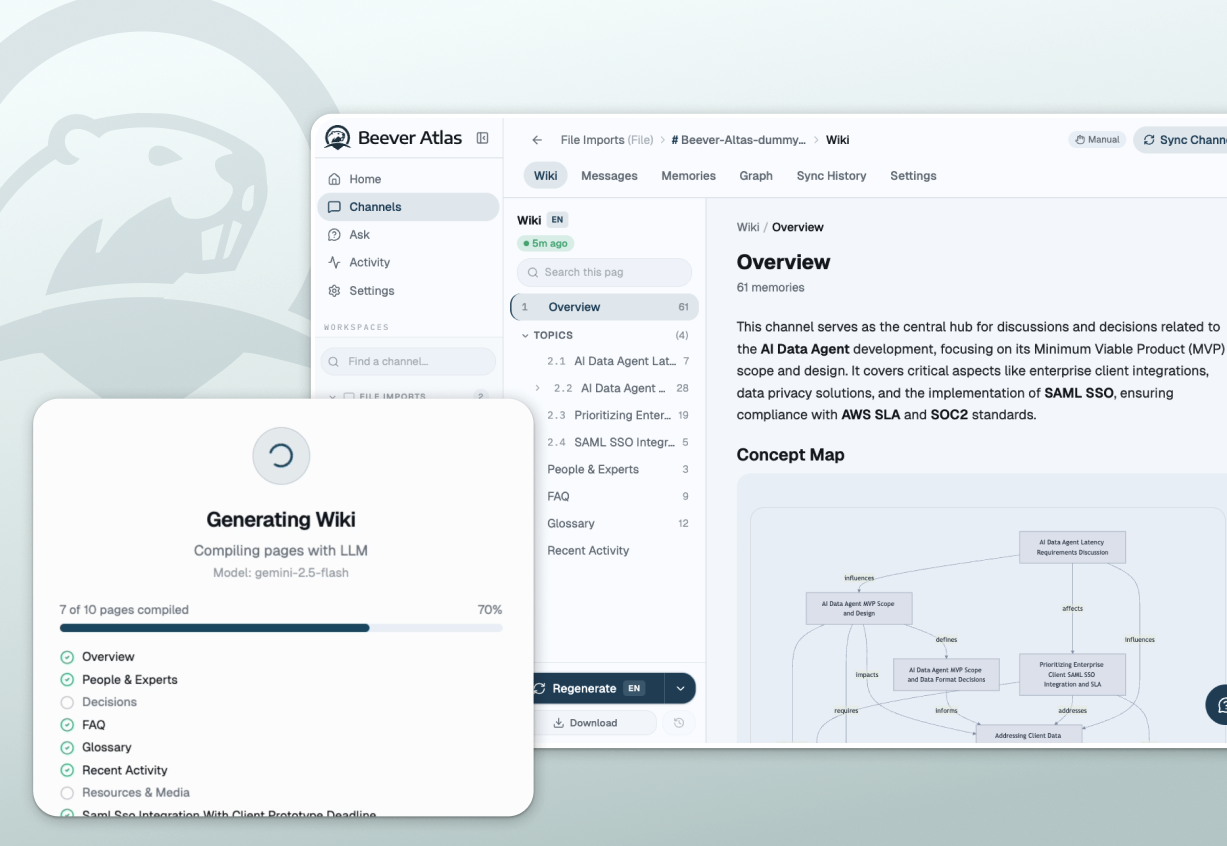
Beever Atlas turns scattered team chats, notes, and documents, into a permanent, cited AI memory center and LLM wiki. I joined after the CTO and an AI engineer had already built v1 and shipped it. GTM, the v1→v2 direction, and the UX/brand work.








Everything Atlas reads from — Slack, Teams, Google Drive, Jira, and email landing in v2.
01
Sources
Slack · Teams · Drive · Jira
02
Ingest & cite
Every fact keeps its source
03
Memory spaces
Semantic + graph, RBAC applied
04
Living wiki
Pages recompile themselves
Agents over MCP — AI agents read and write the same memory
02
Target user
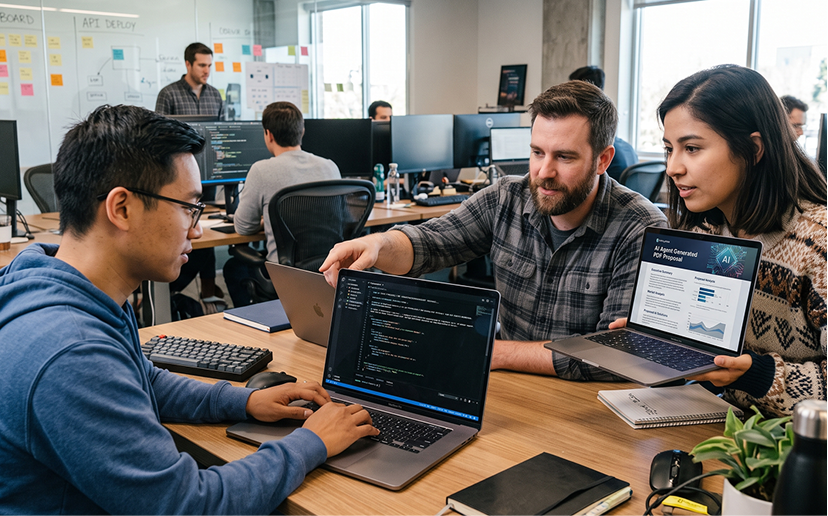
The teammates who run their own agents
AI-literate
Delegates day-to-day ops to their agents.
Context work
Copies threads, docs and decisions before agents can act.
Cross-domain work
Across marketing, product, sales, etc.
03
Situation
Every tool had its own way of saving knowledge — and v1's real flaw was a security one, not a hypothetical.
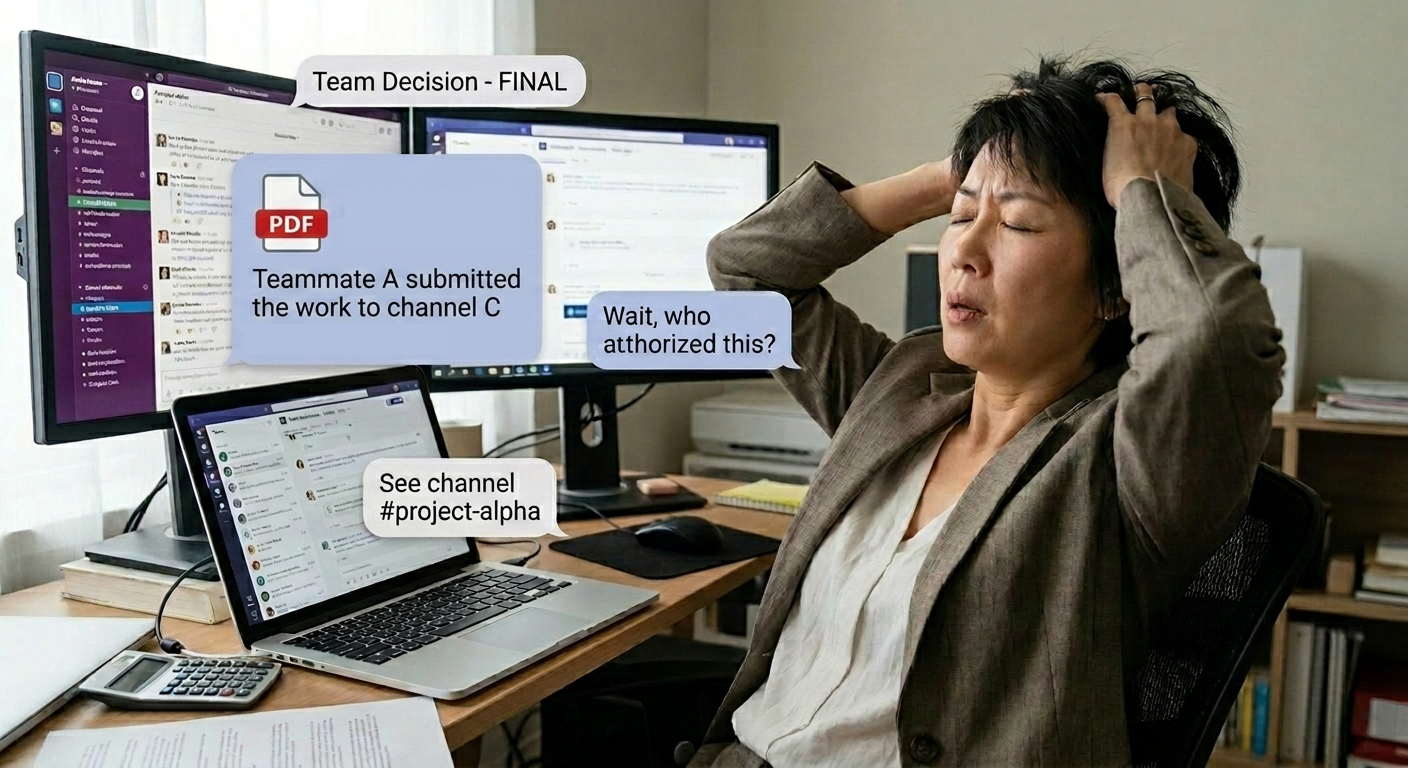
Conversational knowledge loss
Knowledge points and key dicision makings scattering in different locations, different formats(e.g. Audio, images, pdf, and notes).
Ambient authority — v1's real flaw
v1 used one field to do four jobs at once, including access control. Anyone who could reach the bot could ask about any synced channel.
User side
Everyone use diverse tools and formats. They aren't easy for an agent to pick up.


Votee side
v1 was AI research-initiated and the product shipping journey is unclear.
Six tools, six silos
Every tool remembers differently. None of it connects.
Slack
Starred message
in-app only
Linear
Thread summary
in-app onlyGmail
Labelled email
in-app onlyDocs
Meeting notes
not searchableCalls
Audio recording
not searchableScreens
Screenshot
not searchableChat & email: searchable in-app only. Notes, audio, screenshots: not searchable anywhere.
No benchmark fit the case
We had no quantitative metrics to show clients why our memory layer was actually better — no existing AI industry benchmark measured a cited, permission-aware agent-plus-memory system in our case.
04
The memory pipeline
Eight agents read the stream. Nobody hand-maintains a page.
Injection agents
8 small agents read the stream and file every fact — atomic, cited, and permission-stamped.
Dreaming stage
Periodically revisits the wiki to deduplicate facts, reconcile contradictions, and topics.
Permission tagging
Every fact carries its own permission stamp — two people open the same page, each sees only what they're allowed to.
What did we promise this account on renewal?
Answering as PM
Pricing holds for 12 months, and the team agreed not to commit to migration help before scoping it. Nothing I can see records a final answer on migration.
Answering as Sales
Pricing holds for 12 months, and migration was promised free for the first quarter — committed on the renewal call, after the team had flagged it as unscoped.
One question, one wiki. Sales is cleared for the call transcript where the promise was actually made; the PM is not, so their answer stops at its own edge instead of guessing.
Full model-selection table
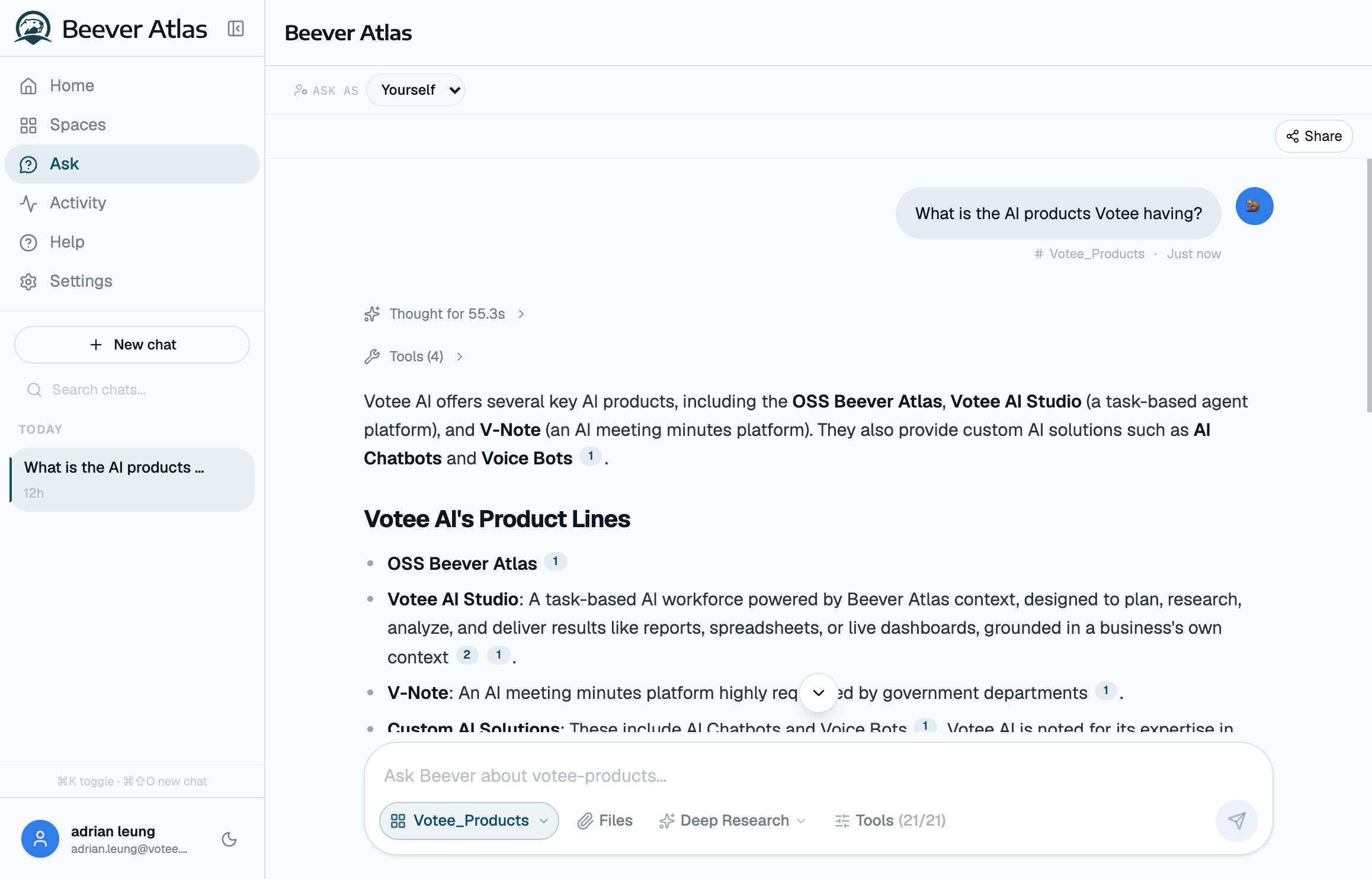
Pull memory into an agent
- 1
A teammate is mid-task in Claude Code.
- 2
The agent calls the Beever Atlas skill over MCP.
- 3
It gets cited facts back, mirrored to that person's permissions.
 claude code
> /beever-atlas-memory "what's our GTM decision?"
⏺ beever-atlas MCP · ask_wiki
⎿ 1 wiki page cited — Marketing & Biz
The manager decided to go ahead with the GTM strategy A at 2026-07-24.
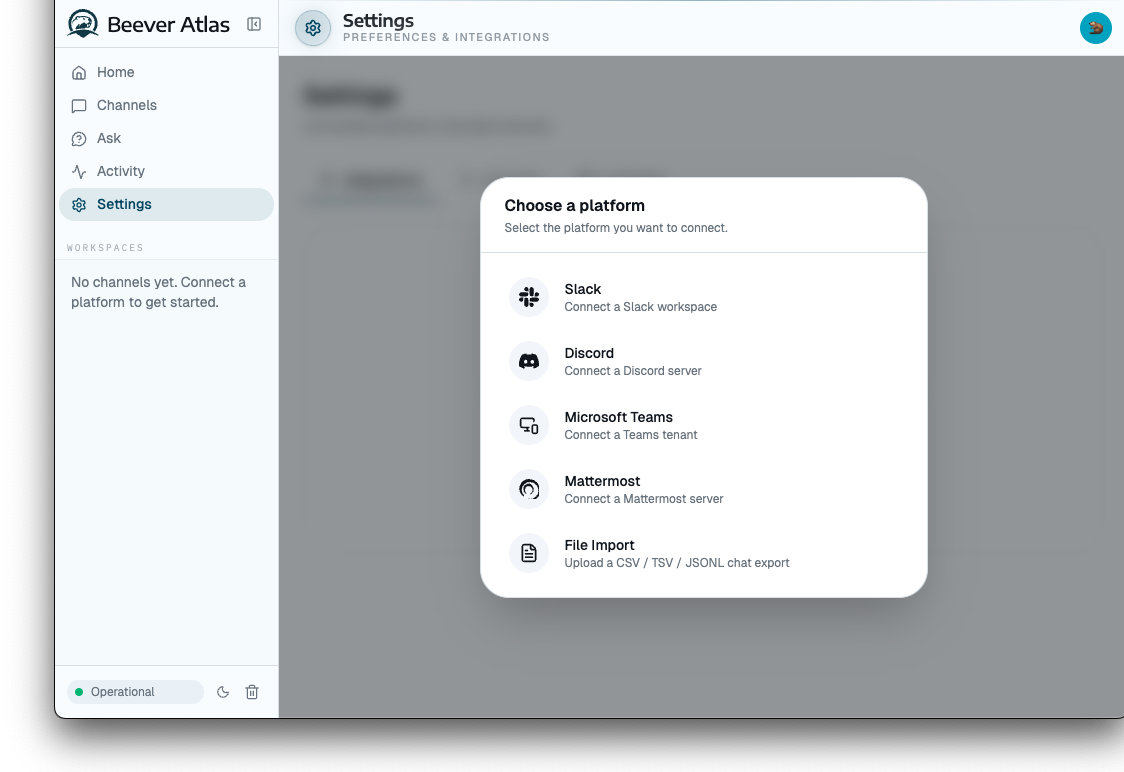
From channel to space
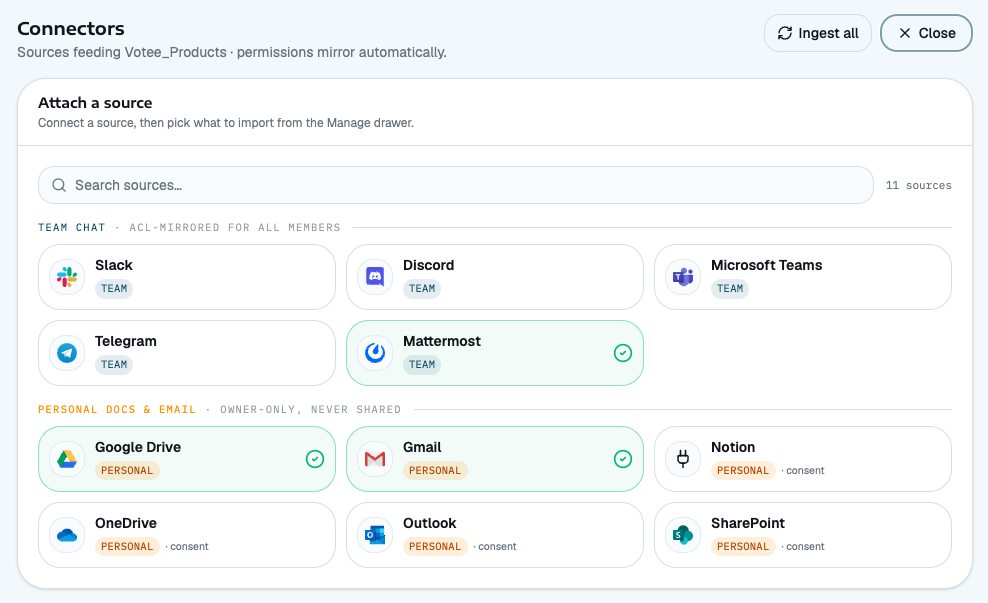
The Space comes first; sources and people attach to it.
One field forced to do four jobs → one container built for two relationships.
v1 · One field
Never built to do four jobs — it just ended up doing them all.
v2 · Container
Built to do one job — sources and people attach to it on purpose.
Sources
Members
05
Why do we know if that's better?
BeeverBench: a synthetic benchmark built to answer one question: Does the agent actually retrieve information well?
- 71.2%
- atlas-deep accuracy
- +34.2pts
- accuracy delta vs. rag-rerank
- 75.0%
- grounding precision
- 46%
- wiki coverage recall
vs. 37–39% for both RAG-only arms
95% CI [25.0, 43.5], McNemar p = 0.016
90/120 sampled facts — 0.8% true hallucination
23 of 50 wiki-worthy facts stated — the honest gap
Full evaluation framework — 9 experiments, 3 stages
06
Decisions from different AI Product aspects
Even a fully AI-approved fix still needs a human to say go.
Deterministic
Leak check
Access control and the leak check — resolved against the asker's real identity, never inferred by a model.
Fact-level RBAC
Fact-level RBAC — every fact carries its own permission stamp, so the check runs per fact rather than per channel.
Gray zone
Budget gap
Clients want deterministic BI, and the early adopters who want it first don't have the budget for it.
Code-exec gateway
Apply the AI agents' code-execution logic as the injection and extraction gateway — code pulls the exact numbers, the agent only frames them.
Probabilistic
Answer variance
Extraction, synthesis and answers are LLM-driven — the same question can come back worded differently, and buyers read that as unreliability.
Published benchmark
Built BeeverBench — 92 questions across four arms — so the variance is measured and published rather than argued about.
07
Impact & Results
Growth highlights and areas of achievements.
- #453
- of 18,000+ MCP servers
- 6
- AI-agent discovery registries
- 3
- sectors show enterprise interest
Ranked on PulseMCP.
Listed at launch.
A HK utility, a government hotline service, a HK telecoms operator — interest, not signed deals.
Why open-core, not open-source
Open source is mainly for the fund-raising purposes. Elasticsearch open-sourced fully, AWS forked it into a free managed service, and Elastic had to retreat to a restrictive licence to survive. Features commoditise; operations don't. So the core stays MIT and the enterprise layer sells SSO, audit and compliance.
Cost and unit economics
08
AI workflow at a glance
I directed the design and brand work myself; the engineering team ran its own named, multi-model pipeline for anything higher-stakes.
Claude Code — Multi-agent harness (OMC) for the explainer site and my own UX/brand work — typed roles: explore, executor, reviewer, security-reviewer.
Mermaid — Architecture diagrams and internal docs, all authored as SVG/code — a model change updates the diagram, not a redraw.
Langfuse — AI observability — usage and metering records, plus LLM-as-a-judge evaluation on live traces.
GitHub — CI gate — CodeQL static analysis, coverage thresholds, typecheck and format checks, before any merge.
Linear — 745 tracked tickets, RES-### prefix, the Research team's full backlog and roadmap.



Teammates involved
Agents did the typing. These are the people who set the direction, argued the trade-offs and reviewed what shipped.
 The research lead
 CTO
CTO AI engineer
 Legal
Legal